


The hotel guest experience is not only what happens during the stay.
It is also what the team learns after the stay, how quickly managers respond, and whether recurring signals turn into property action.
For operators, the hard part is connecting scattered reviews, sentiment, response status, comp-set context, and rate pressure. Halo GSS brings those signals into one guest satisfaction workflow so reputation work can support better operating decisions.
Hotel Guest Experience Starts With Review Coverage
Guests describe the stay in many places.
Google, TripAdvisor, Booking, Yelp, Expedia, and other public channels all shape how future guests read a hotel before they book. If the team checks those channels manually, the picture is always partial. A manager may catch the most visible complaint and still miss the pattern that matters.
Tripadvisor 2025 Transparency Report says its community shared 79.7 million contributions in 2024, including 31.1 million reviews. That scale explains why the hotel guest experience cannot be managed through occasional portal checks.
Halo GSS centralizes review aggregation across major sources so hotel teams can see the guest story in one place. The benefit is not just fewer logins. It is a cleaner operating rhythm: what came in, what changed, who responded, and which issue deserves attention.
Feedback Needs Ownership, Not Just Visibility

A review is useful only when someone owns the next step.
Some feedback needs a public response. Some points to a training issue, a housekeeping follow-up, a breakfast problem, or a rate-value conversation. If feedback only appears in a report, the hotel has visibility without motion.
Expedia Group hotel guest reviews guidance reports that 55% of U.S. and UK travelers who recently visited Expedia said positive reviews are important when choosing accommodations. That makes response coverage part of demand generation, not only service recovery.
Halo GSS supports that response loop with a centralized inbox, review status visibility, and AI-drafted responses that managers can review before sending. AI helps reduce blank-page work, but local judgment still matters. The property team should decide tone, escalation, and the operational fix.
For teams tightening the response workflow, Halo GSS also has a practical guide to hotel review management.
Sentiment Shows What Is Shaping The Stay
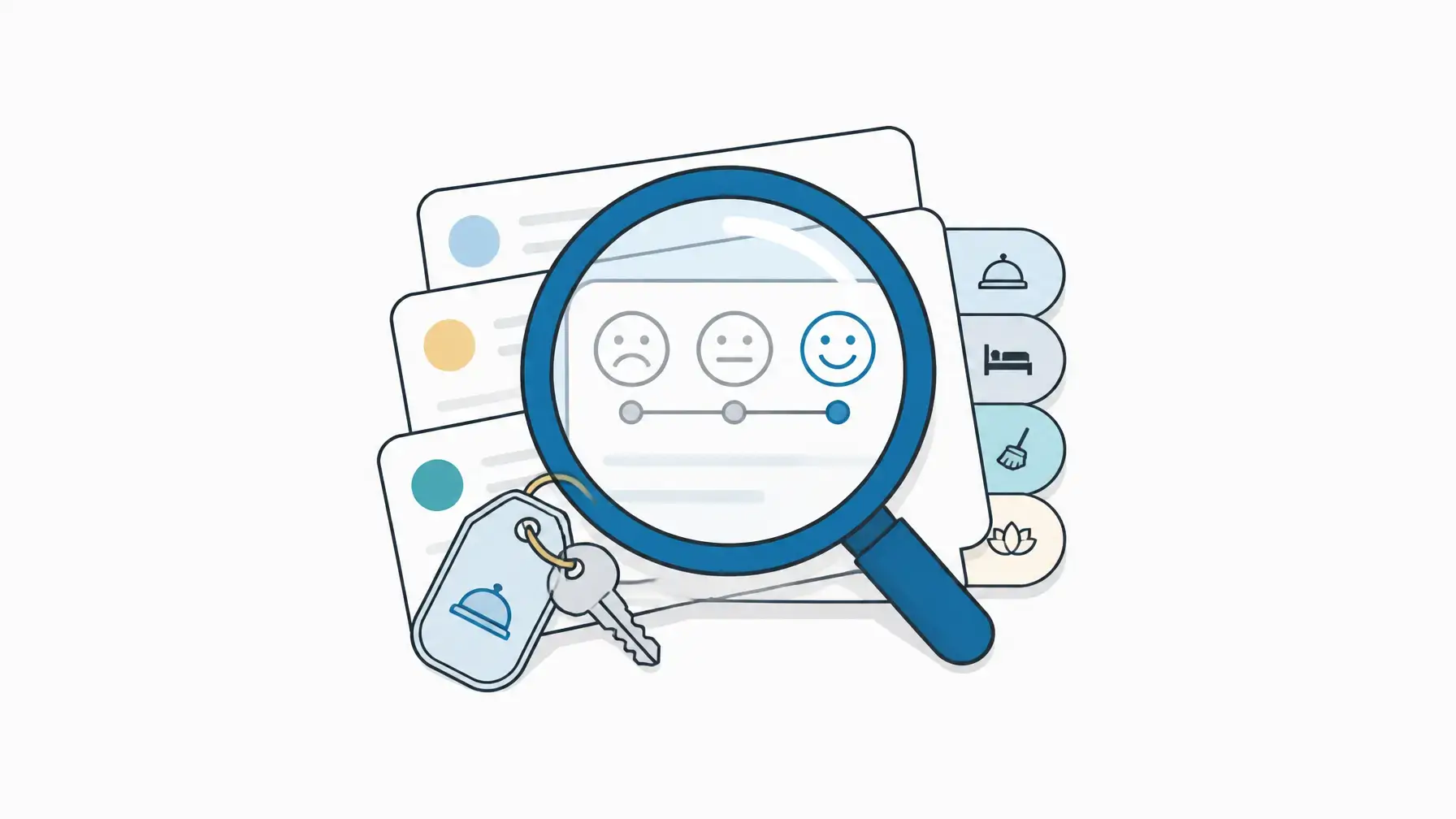
A star rating is a signal, but it is not a diagnosis.
The team needs to know whether guests are reacting to cleanliness, staff service, room condition, value, amenities, location, breakfast, or another part of the stay. Without that layer, managers can spend time answering reviews without changing the experience behind them.
Expedia content guidelines show how category-level feedback works in practice: travelers can submit sub-scores for aspects of a stay such as cleanliness, staff, breakfast, and location. Those categories are closer to the operating work hotel teams actually manage.
Halo GSS organizes feedback into 11 sentiment categories so GMs and regional leaders can see what is moving the hotel guest experience. A single property can spot a recurring service issue. A portfolio team can compare patterns across hotels. Ownership can see whether the issue is isolated, repeated, or market-wide.
The same discipline applies when public reviews and private feedback are reviewed together. Halo GSS explains that connection in its guide to guest satisfaction survey workflows.
Rate Context Changes The Guest Experience Conversation
Guests judge experience and price together.
If rate climbs while value sentiment weakens, the guest story changes. If a competitor charges more and carries stronger cleanliness or service sentiment, the comp-set conversation changes too. Operators need both sides of the story before deciding whether to adjust price, coach a team, fix a process, or explain performance to ownership.
J.D. Power 2026 North America Hotel Guest Satisfaction Study is based on responses from 44,787 branded hotel guests and found overall satisfaction improved 13 points on a 1,000-point scale. The largest improvement was value for price paid, up 18 points.
That finding is useful because it keeps the hotel guest experience tied to value. Guests may love a room at one price and criticize the same room at another. Halo GSS helps teams look at guest perception beside competitor and rate context so operations, revenue, and ownership can discuss the same property story.
Teams comparing requirements can also read how hotel reputation management software should move beyond review monitoring.
Owners Need The Business Story Behind Guest Experience

Owners do not need every comment in the weekly meeting.
They need to know what the guest story means for the asset.
A useful owner summary connects guest perception, category-level sentiment, response coverage, rate position, comp-set movement, and property action. It shows whether the team is handling an isolated complaint, a repeating service issue, a pricing mismatch, or a market comparison problem.
The HIA-connected Halo GSS story goes further when configured. The Halo GSS about page explains that Halo GSS was built to connect guest perception, competitor pricing, and HIA performance context so hotel teams can see which reputation signals are changing the business story.
HIA customer Jeff Desai described the value of connected intelligence this way: “This is exactly the intelligence tool we were looking for at Baywood. It is so helpful to see the different KPIs at a glance and have the flexibility to segregate the data and drill down for deep analysis.”
That is the standard hotel guest experience reporting should meet. It should help the team decide what to fix, how to respond, where to price, and what to explain.
What Strong Hotel Guest Experience Management Looks Like
Strong hotel guest experience work has a few recognizable patterns:
- Review coverage spans the major guest-facing sources.
- Response ownership is visible by property and status.
- Sentiment analysis identifies the stay driver behind the score.
- Comp sets are reviewed against the market guests actually see.
- Rate context sits beside guest perception, not in a separate tool.
- Regional leaders can compare properties without rebuilding reports.
- Owners receive a business explanation, not a screenshot collection.
- AI drafts support manager judgment instead of replacing it.
Hotel Management covered Cornell research showing that hotels that began responding to reviews received 12% more reviews and saw average ratings increase by 0.12 stars. The exact lift will vary by market, but the lesson is practical: response discipline and visibility can change how a property is perceived.
Halo GSS pricing keeps the product scope clear: review aggregation, centralized inbox, AI-powered review responses, advanced analytics, competitor tracking, portfolio dashboards, and multi-property comparison are part of the Professional tier, while HIA ERP-connected financial context is part of the Portfolio path.
For a broader operating view, Halo GSS also explains online reputation management and hotel reputation management for hotel teams.
Key Takeaways
- Hotel guest experience management should connect feedback, response, sentiment, comp sets, and rate context.
- Reviews need ownership and status visibility, not only monitoring.
- Sentiment categories help teams see what part of the stay needs attention.
- Rate and value perception should be reviewed together.
- Halo GSS gives hotel teams one workflow for turning guest signals into better property decisions.
FAQ
What does hotel guest experience mean?
Hotel guest experience is the full impression a guest forms before, during, and after a stay. For operators, it includes the service delivered on property, the feedback guests leave afterward, and the actions the team takes when patterns appear.
Why is hotel guest experience important?
It matters because guest perception affects reviews, booking confidence, rate resistance, loyalty, and owner conversations. A hotel can have strong operations in some areas and still lose demand if recurring guest concerns are not visible and addressed.
How can hotels measure guest experience?
Hotels can measure guest experience through public reviews, response status, category-level sentiment, guest satisfaction surveys, comp-set comparison, and rate-value signals. The strongest view combines those sources instead of treating each one as a separate report.
What role do reviews play in guest experience?
Reviews are the public record of how guests describe the stay. They help future guests evaluate the hotel and help managers see where experience, expectation, and value may be drifting.
How does sentiment analysis help hotel teams?
Sentiment analysis groups guest comments into categories that managers can act on. Instead of only seeing that a score moved, hotel teams can see whether guests are talking about cleanliness, staff, value, amenities, location, or another part of the stay.
Should hotels respond to every review?
Hotels should have a clear response policy, especially for negative, detailed, or operationally useful reviews. The goal is timely and thoughtful coverage, not generic replies that ignore the real issue.
How does rate context affect guest experience?
Guests judge experience through the price they paid and the alternatives they considered. When rate context sits beside reviews and sentiment, teams can better understand whether pressure is coming from price, perception, market choice, or property execution.
How is Halo GSS different from a basic review tool?
Basic tools often focus on monitoring and replying to reviews. Halo GSS connects review aggregation, 11-category sentiment, AI-supported responses, comp sets, rate intelligence, alerts, portfolio dashboards, and multi-property comparison.
Can Halo GSS support multi-property hotel teams?
Yes. Halo GSS supports portfolio dashboards, leaderboards, multi-property comparison, alerts, and saved comp sets. That helps regional and ownership teams see which hotels need attention without rebuilding the story manually.
How does Halo GSS work with HIA?
Halo GSS was built by HIA and can connect guest perception, competitor pricing, and HIA performance context when the Portfolio path is configured. That gives finance, ownership, and operations leaders a clearer business explanation behind guest experience movement.